

.jpg)
Key Takeaways
- By removing the logistics of commuting, a home gym makes it easier to engage in more frequent, more consistent workouts.
- Home gym success depends on your personality and the space you create.
- While smart gym systems like Tonal or Peloton offer high-tech equipment and workout options, you don’t necessarily need a massive budget to start.
that {{mid-cta}}
With the chaos of busy work schedules and life taking you by surprise, consistently going to the gym can feel like a train you’re always chasing. When combined with expensive gym memberships, why not turn work-from-home into workout-from-home! It’s not a matter of effectiveness, as home workouts remain effective for targeting health and fitness goals.1 However, it’s more of a conversation of convenience and consistency.
This article walks through the practical benefits, potential downsides, and critical decision points to help you decide whether an in-home setup is a wise investment for your lifestyle and fitness goals.
Benefits of Having an In‑Home Gym
.jpg)
The most immediate draw of a home gym is the unparalleled convenience and flexibility it offers. While the initial investment can be high, the cost savings over time are significant. A home setup provides a sanctuary of privacy, comfort, and control, allowing you to curate your own workout environment without waiting in line for a machine or feeling self-conscious in a crowded room.
By removing the logistics of travel and the recurring fees for amenities you don’t use, you unlock a much greater potential to stay consistent and enjoy your workout routine.
Drawbacks and Limitations of In‑Home Gyms
.jpg)
While the dream of a private fitness haven is enticing, it may come with a few logistical and personal hurdles. Here are some of the possible trade-offs to consider before making the transition:
- Significant Upfront Cost and Space Requirements: A home gym requires a large initial investment for high-quality materials. You need a dedicated, well-ventilated area that sacrifices a room in your home, which may not be feasible in smaller spaces.
- Limited Equipment Variety: Due to space and budget constraints, you won't have access to the variety of specialized cable machines, diverse cardio options, or heavy-duty weight-lifting equipment found in commercial gyms.
- Motivation and Accountability Challenges: Without the social energy of other lifters or the presence of a trainer, it can be easier to cut a workout short or skip it entirely when the comforts of your living room are just a few steps away.2
- Potential Plateaus or Boredom: Sometimes, we just need to get out of the house or a change of scenery. Without the environmental "reset," your progress may stall due to a lack of variety and becoming sincerely bored.
How to Tell If a Home Gym Is a Good Fit for You
.jpg)
To ensure your investment leads to results rather than regret, give an honest look at your habits and environment.
- Space: Do you have enough dedicated room for bulky equipment? Are you willing to use a multipurpose area (e.g., a living room) where equipment may need to be folded or moved frequently?
- Budget: Can you afford the upfront cost of quality equipment and the build-out of the space?
- Personality and Motivation Style: Do you thrive in self-led routines and training alone, or do you benefit from the social energy of a group class and busy gym?
- Fitness Goals: Are your needs relatively simple, or does your training require a high level of variety and equipment?
- Schedule and Lifestyle: Do time constraints, a long commute, or family demands make a home gym the only realistic way to stay active?
Ways to Make a Home Gym Work (If You Go For It)
.jpg)
Building a home gym successfully involves a few smart strategies and helpful tips. It may be helpful to start small, utilizing adjustable dumbbells and resistance bands. As you grow and find your consistency, focus on building a minimal yet versatile setup with a bench, barbell, and squat rack, while still relying on bodyweight exercises for cardio bursts.
If you’re feeling uncertain about training where you live, then make sure to create a separate, dedicated workout space to cue your brain into "training mode" and minimize household distractions. Preventing boredom and plateaus can be achieved through structured programming and tracking tools, or by seeking a personal trainer who programs remote training routines.
All this to say that periodic gym visits or classes can still provide a necessary change of pace and social energy, keeping your routine exciting.
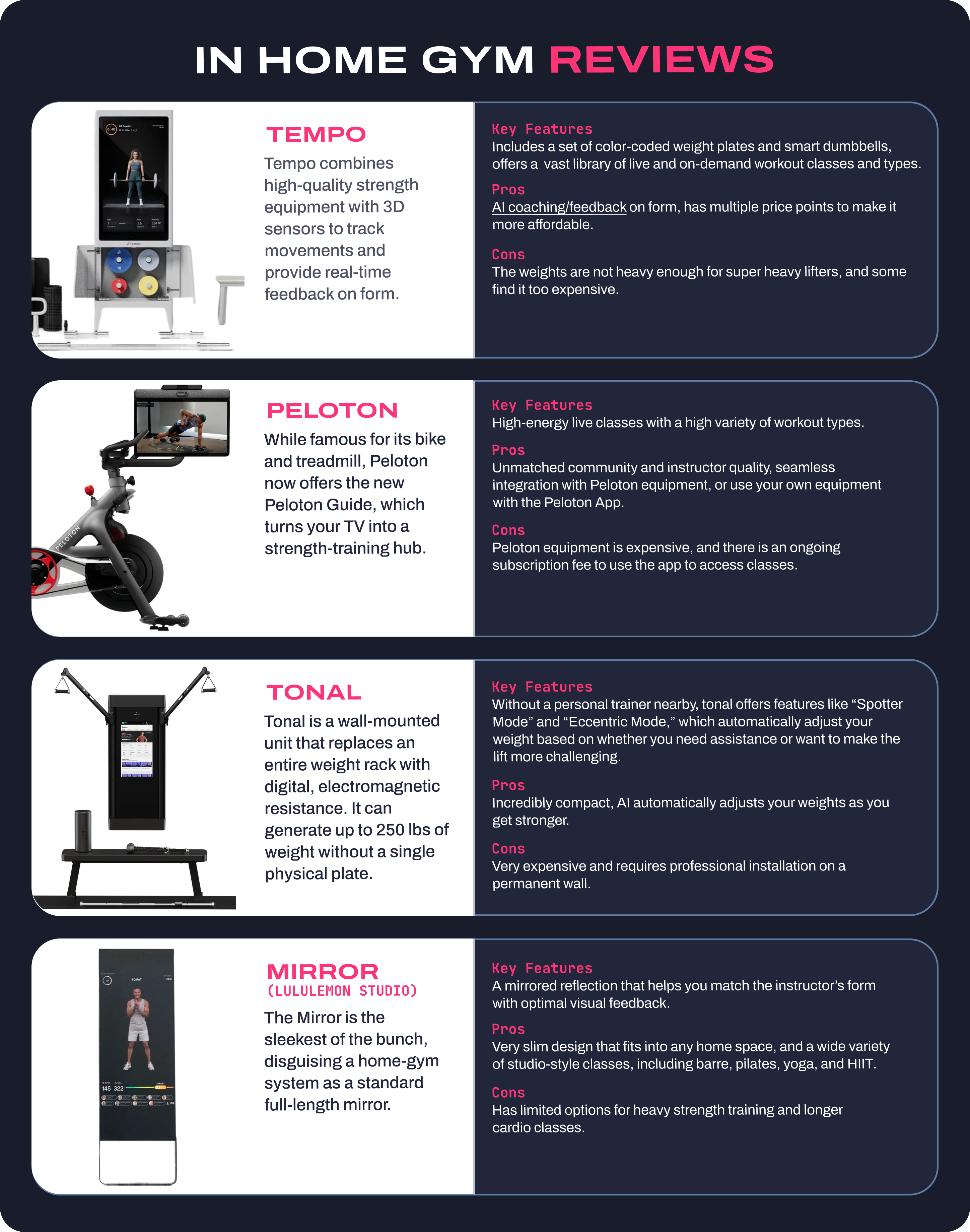
Your Guide to In-Home Gyms
For those looking to digitize their home gym experience, here is a breakdown of Tempo, Peloton, Tonal, and Mirror to help you choose which fits your training style and home space.
How This Decision Connects to Metabolic & Glucose Health
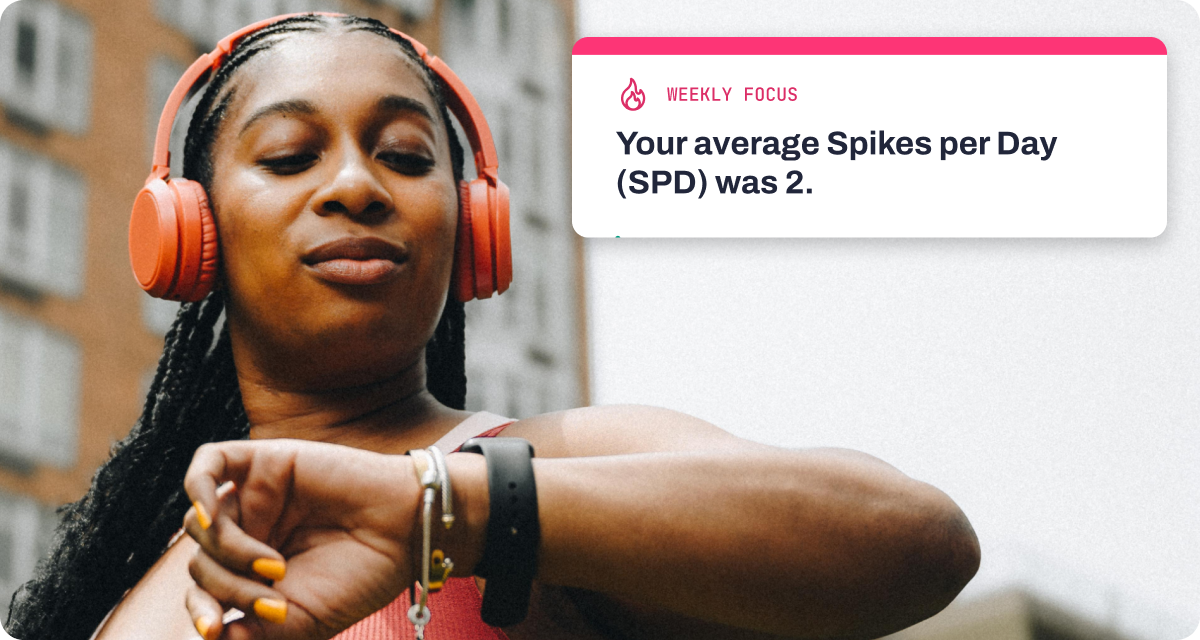
For individuals focused on glucose stability and metabolic health, a home gym can be a powerful tool for consistency. One of the most effective ways to blunt post-meal blood sugar spikes is immediate movement, and having equipment just steps away removes the friction of “getting to the gym.” A home setup makes it easier to fit in short, effective post-meal microworkouts (such as a five-minute kettlebell circuit or a quick treadmill walk) that may otherwise feel unrealistic.
With Signos and a continuous glucose monitor (CGM), you can see how these small bouts of movement influence your glucose in real time. By tracking workouts alongside meals, sleep, and daily routines, you gain a clearer picture of how exercise timing and frequency support steadier energy and improved metabolic resilience.
Signos features that support home-gym habits:
- Real-time glucose tracking (CGM): Watch how quick post-meal movement helps reduce glucose spikes and speeds recovery.
- Workout and meal logging: Log short workouts and meals to connect movement timing with glucose outcomes.
- Daily insights (Dailies): Get day-by-day feedback highlighting when movement supported better glucose stability.
- Weekly Insights report: Review trends to see how consistent at-home workouts impact overall glucose variability and energy.
Experiments to try with Signos:
- Post-meal movement test: Compare glucose responses after meals with a 5–10 minute home workout versus no movement.
- Microworkout frequency experiment: Test one longer workout per day versus multiple short sessions to see which approach keeps glucose steadier.
- Workout timing experiment: Compare morning, afternoon, and evening workouts to observe differences in glucose response and recovery.
- Exercise type comparison: Alternate between strength, cardio, and mixed sessions to see which best supports post-meal glucose control.
By pairing the convenience of a home gym with real-time glucose data, daily feedback, and weekly trend analysis, Signos helps turn small, frequent movement into a sustainable strategy for stable energy, better insulin sensitivity, and long-term metabolic health.
The Bottom Line
A home gym can absolutely be worth it, especially if you value convenience, long-term savings, privacy, and consistency. It’s particularly appealing if you have limited time or don’t enjoy public gyms. To ensure success, start with a minimal, high-utility setup and focus on the psychological habit of "showing up" in your own space, so your environment finally works for your goals rather than against them.
Learn More About Signos’ Expert Advice
If you have more questions about improving your health, fitness, and nutrition, seek expert advice from a continuous glucose monitor and the Signos app. A continuous glucose monitor (CGM) can give you the insights to make smarter nutrition and exercise choices. The Signos app provides a unique, personalized program to help you reach your health goals.
Topics discussed in this article:
References
- Nguyen, T. H., Yamamoto, T., Cho, D., Nguyen, T. L., Goldman, P., & Dolezal, B. A. (2025). Five Years Later—The Impact of the COVID-19 Pandemic on Physical Performance and Cardiometabolic Health Using a Smart Home Gym: An Ecological Case Study. International Journal of Environmental Research and Public Health, 22(5), 762.
- Carron, A. V., Hausenblas, H. A., & Mack, D. (1996). Social influence and exercise: A meta-analysis. Journal of Sport and Exercise Psychology, 18(1), 1-16.
- Engeroff, T., Groneberg, D. A., & Wilke, J. (2023). After dinner rest a while, after supper walk a mile? A systematic review with meta-analysis on the acute postprandial glycemic response to exercise before and after meal ingestion in healthy subjects and patients with impaired glucose tolerance. Sports medicine, 53(4), 849-869.

.svg)





.webp)


.svg)
.svg)
.svg)
.svg)
.svg)
.svg)
.svg)
