


Key Takeaways
- A registered dietitian is a credentialed healthcare professional who must complete advanced education and training to practice medical nutrition therapy, adhering to strict ethical, practice, and education standards to maintain credentials and licensing at the state and national levels.
- Unlike nutritionists or health coaches, dietitians have specialized training to interpret health data and prescribe therapeutic nutrition plans for complex or coexisting medical conditions.
- Working with a dietitian to support your metabolic health goals can help you apply evidence-based and personalized strategies with accountability for sustainable habit change.
that {{mid-cta}}
Every social media app, magazine, and news show features the latest diet craze, offering advice on everything from weight loss to diabetes and digestive issues. Even when you do start looking for more personalized advice, knowing who to work with can be confusing.
While many nutritionists or health coaches are able to help guide general healthy eating choices, registered dietitians are credentialed experts who help translate science into personalized nutrition care to help you meet your goals. They’re knowledgeable about food and nutrition, and also trained to assess your health status, interpret lab work, and create therapeutic plans for complex or coexisting medical conditions. If you're managing insulin resistance, navigating PCOS symptoms, or trying to stabilize your glucose to improve energy and reduce cravings, you need someone who can provide Medical Nutrition Therapy, not just motivation or generalized advice.
This guide breaks down how dietitians are trained, what they actually do, and how they differ from other nutrition professionals so you can choose the right support for your health goals.
What Is a Registered Dietitian (RD/RDN)?

A registered dietitian is a credentialed and licensed nutrition expert who meets national standards for education, training, and practice. You may see the credentials RD (Registered Dietitian) and RDN (Registered Dietitian Nutritionist), which are interchangeable and indicate that the Commission on Dietetic Registration (CDR) has approved the accreditation.
Dietitians complete a master's program (before 2026, a dietitian may hold a bachelor’s degree), a dietetic internship, and sit for a board exam to be qualified to provide Medical Nutrition Therapy (MNT). This service uses nutrition interventions to prevent, treat, and manage health conditions. This sets them apart from other wellness professionals who may offer general guidance but can't legally provide therapeutic nutrition care.
You'll find dietitians working across a wide variety of settings, including hospitals, outpatient clinics, corporate wellness programs, private practices, and community health centers. Some dietitians also hold more unconventional roles, such as consulting, nutrition sales, journalism, or public relations. Regardless of where they work, dietitians use evidence-based guidelines to assess your health status and create nutrition strategies tailored to your unique medical history, status, life circumstances, and goals.
Education and Credentials Required to Become a Dietitian

Registered dietitians spend six or more years obtaining higher education and training to develop the skills and knowledge required to practice medical nutrition therapy.1 As of 2026, registered dietitians must obtain a master’s degree through the Accreditation Council for Education in Nutrition and Dietetics-accredited Didactic, Coordinated, Graduate\, or International program. Courses include everything from food science to advanced human physiology, medical nutrition therapy, counseling skills, nutrition research, and food service.
In addition to a graduate degree, at least 1,000 hours of supervised practice experience must be completed. This experience provides real-world practice for clinical and community nutrition, food service, and other specialty areas of interest.
Once a person completes education and experience, they must pass a national exam, meet state licensure requirements, and maintain continuing education credits to keep their credentials.
This regulation protects you as a consumer, ensuring you’re working with someone who has been verified to have received the required education and training and maintains good legal and ethical standing.
What Dietitians Actually Do

While dietitians do sometimes create meal plans, that’s only one small part of their work. Dietitians who work directly with patients or clients spend the majority of their time on comprehensive nutrition assessments and ongoing clinical care.
If you're seeing a dietitian, they'll gather information about your diet, health history, lab results, medications, symptoms, lifestyle, and goals. They focus on understanding how your body responds to food and what barriers you're facing, not just what you're eating.
From there, they will work with you to create an individualized eating plan that accounts for your metabolism, preferences, schedule, limitations, health conditions, and more.
While dietitians can support a wide variety of health, fitness, and wellness goals, they’re uniquely qualified to support chronic conditions like diabetes, PCOS, heart disease, and autoimmune or digestive disorders. This might include carbohydrate counting for glucose management, elimination diets to identify food sensitivities, or low-FODMAP protocols for IBS.
As you begin implementing changes according to your nutrition plan, dietitians can support your efforts and monitor progress through follow-up appointments, reviewing changes in lab work, symptoms, and metabolic data, such as continuous glucose monitor (CGM) trends. As you make progress, your priorities shift, or symptoms, labs, or conditions change, your dietitian will work with you to adjust the plan to meet your needs along the way.
In clinical settings, dietitians collaborate with your medical team, communicating with physicians, endocrinologists, and other healthcare providers to ensure your nutrition care aligns with your overall treatment plan.
Specialties Within Dietetics
Dietetics is an incredibly diverse field with numerous specialty areas and practice methods. Even beyond specialties, many dietitians are well-suited to hold unconventional roles, using their nutrition expertise to support other areas of the food and wellness industry. Traditionally, you’ll find dietitians in these areas:
- Clinical dietitians often work in hospitals, nursing homes, and other healthcare settings, collaborating with medical teams to provide nutrition support for acute illness, post-surgery recovery, and the management of chronic diseases.
- Sports dietitians support athletes with performance nutrition, hydration strategies, and body composition goals.
- Pediatric dietitians specialize in child and adolescent nutrition, addressing growth concerns, food allergies, and feeding difficulties.
- Renal dietitians specialize in kidney disease and create nutrition plans to manage fluid, electrolyte, and protein intake.
- GI and gut health dietitians focus on digestive disorders like IBS, Crohn's disease, and celiac disease, often using therapeutic diets to reduce symptoms.
- Eating disorder dietitians specialize in supporting recovery from anorexia, bulimia, binge eating disorder, and other disordered eating patterns. They work in inpatient care centers or outpatient facilities, helping to rebuild a healthy relationship with food, challenge food rules, and establish sustainable eating patterns that support both physical and mental health.
- Metabolic and diabetes care dietitians specialize in glucose management, insulin resistance, and metabolic dysfunction.
- Corporate and wellness dietitians focus on work environments, creating programs that support employee health through nutrition education and preventive care.
Many dietitians hold additional advanced certifications beyond their RD credential in areas, including:
- Sports Nutrition (CSSD)
- Oncology Nutrition (CSO)
- Pediatric Nutrition (CSP)
- Obesity and Weight Management (CSOWM)
- Renal Nutrition (CSR)
- Gerontological Nutrition (CSG)
- Pediatric Critical Care (CSPCC)
- Advanced Practice Clinical Nutrition (RDN-AP or RD-AP)
- Digestive Health (CSDH)
Dietitian vs. Nutritionist vs. Health Coach: What’s the Difference?

A registered dietitian, nutritionist, and health coach can all support your health goals, but they have very different qualifications and scopes of practice.
Dietitian (RD/RDN)
Dietitians require accredited education combined with supervised practice hours to develop the knowledge and skills to practice in medical settings. They must pass a national certification exam and can provide Medical Nutrition Therapy for diagnosed medical conditions. Dietitians are legally regulated in most states, ensuring they meet consistent education and ethical standards. In 2026, to become a registered dietitian, individuals must achieve a master’s degree.
Nutritionist
"Nutritionist" is a broad, unregulated term that varies widely in terms of training and education. Some nutritionists have formal training in nutrition science, while others have minimal or no formal training. Without additional licensure, nutritionists cannot provide Medical Nutrition Therapy or treat medical conditions. Working with a non-credentialed nutritionist may be a great option for general healthy eating guidance and support rather than clinical intervention. Just be sure to verify their training and education before choosing one.
Health Coach
Health coaches focus on behavior change, habit-building, and accountability. Their training programs vary widely, with no standardized credential required. Health coaches aren't qualified to diagnose conditions or create therapeutic nutrition plans. However, they provide valuable motivation and lifestyle support, often working alongside dietitians or nutritionists in a complementary role to help people adhere to a nutrition and lifestyle plan.
In short, dietitians are clinical experts, nutritionists provide general nutrition guidance, and health coaches specialize in behavior and lifestyle accountability versus specific nutrition recommendations. Many people benefit from a combination of these roles. You might work with a dietitian to manage metabolic health while also receiving coaching to create habits that stick.
How Dietitians Support Metabolic & Glucose Health
Dietitians take a whole-person approach to metabolic health, looking beyond calories to understand how your body responds throughout the day.
They typically assess:
- Health history & symptoms: Past diagnoses, medications, energy levels, cravings, and weight history that may influence glucose control.
- Lifestyle factors: Sleep, stress, movement, work schedule, and routines that impact insulin sensitivity.
- Eating patterns & timing: What you eat, when you eat, and how meals are structured—not just macros or calories.
- Clinical lab data: Markers like fasting glucose, HbA1c, and insulin that reflect long-term metabolic health.
- CGM trends (when available): Continuous glucose data that shows how meals, snacks, exercise, and daily habits affect glucose in real time.
Together, this combination of habits, clinical markers, and CGM patterns helps dietitians understand how your metabolism actually functions, hour by hour, not just in a single lab snapshot.
Signos Features Dietitians May Use
- Real-Time CGM Trends: Review glucose responses to specific meals, snacks, exercise, sleep, and stress.
- Meal & Context Logging: Connect food choices, timing, and composition to post-meal glucose patterns.
- Glucose State Visualization: Use color-coded trends to identify spikes, stability, and recovery patterns at a glance.
- Weekly Insights & Insight Reports: Spot recurring behaviors driving glucose variability and track progress over time.
- Behavioral Experiments: Test small changes (like protein-first meals, earlier dinners, or post-meal walks) and evaluate impact with data.
Meet Signos’ Lead Dietitian
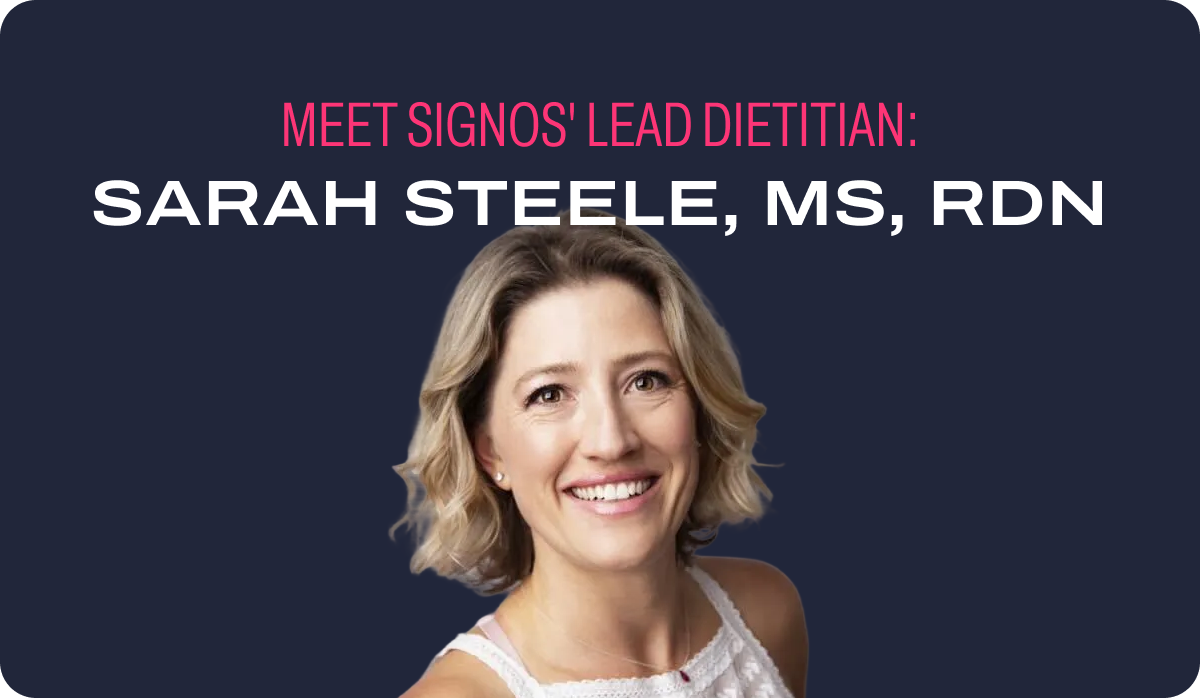
Meet Signos’ Lead Dietitian, who helps translate complex metabolic data into clear, practical guidance.
Sarah is a registered dietitian with a Master’s in Nutrition Science from San Diego State University and a Bachelor’s in Dietetics from San Francisco State. She spent over a decade at Sharp, a leading acute-care hospital, and later worked as a lifestyle and nutrition success coach for a cardiovascular wellness program.
Sarah takes a cutting-edge, integrative, root-cause approach to health by combining clinical expertise, data, and real-world strategies to help members understand their bodies and take charge of their metabolism.
4 Benefits of Working With a Dietitian
Working with a dietitian gives you expert guidance grounded in science and tailored to your body, lifestyle, and goals. Rather than chasing trends or quick fixes, dietitians help you build a sustainable approach to nutrition and metabolic health. With ongoing support, you gain clarity, confidence, and a plan you can actually stick with.
Evidence-Based, Personalized Care
- Guidance grounded in nutrition science, not diet trends or fads
- Recommendations tailored to your health history, lifestyle, and metabolism
- Support for chronic conditions and complex symptoms with a root-cause focus
Whole-Body, Holistic Approach
- Addresses the interplay between nutrition, metabolism, hormones, and medications
- Creates an integrated plan that supports overall health, not isolated symptoms
- Can adapt recommendations as your needs and goals evolve
Sustainable Behavior Change
- Focuses on realistic adjustments you can maintain long-term
- Moves away from quick fixes and restrictive rules
- Builds habits that support lasting metabolic health
Confidence & Accountability
- Ongoing guidance so you’re not left second-guessing food choices
- Support navigating dining out, meal planning, and everyday decisions
- Learn flexible principles you can apply independently for life
The Bottom Line
Dietitians are credentialed nutrition experts with rigorous, standardized training that qualifies them to provide Medical Nutrition Therapy for chronic conditions and complex health concerns. Unlike nutritionists or health coaches, their clinical expertise allows them to assess labs, interpret metabolic data, and create therapeutic nutrition plans tailored to your unique needs.
If you're managing conditions like insulin resistance, PCOS, or diabetes, or simply want evidence-based, personalized guidance that goes beyond generic advice, working with a registered dietitian provides the professional support and accountability needed to achieve lasting results.
Learn More With Signos’ Expert Advice
Signos combines the expertise of registered dietitians with continuous glucose monitoring to help you understand how your body responds to food. Pairing professional guidance with insights from your patterns is one of the best ways to make informed, effective choices that support your energy, metabolism, and overall health. Explore more evidence-based nutrition and metabolic health insights on Signos' blog, or discover how Signos can improve your health.
Topics discussed in this article:

.svg)


.webp)





.svg)
.svg)
.svg)
.svg)
.svg)
.svg)
.svg)
