


Key Takeaways
- Mindful eating during the holidays helps you enjoy your favorite foods with less stress by tuning into emotional triggers and hunger cues.
- Small strategies like slowing down, pairing treats with protein, and using Signos to build awareness can help you make choices that support your health journey.
that {{mid-cta}}
The smell of fresh-baked cookies can feel nearly impossible to resist, especially during the holiday season when holiday gatherings, holiday meals, and trays of pumpkin pie seem to be everywhere.
Food equals connection. Holiday foods bring back memories, comfort, and celebration with family members and loved ones. But they can also trigger stress eating or eating for reasons other than hunger.
Here’s the good news: You can practice mindful eating during holidays and keep your blood glucose steady. When you tune into your hunger cues, support glucose stability, and bring awareness to your eating habits, your mindset and metabolism can work together even when the kitchen beckons you with warm cinnamon and sugar.
The Psychology of Holiday Cravings

The holidays wake up your senses and your cravings. Holiday food cravings are often tied to memories, comfort, and celebration.
The scent of a cookie fresh out of the oven activates the brain’s reward pathways. Scent is directly linked to emotional memory, which means one whiff of gingerbread can transport you to childhood.
The brain reads this as comfort and signals a dopamine-driven craving that can override hunger cues. Even before your first bite, the anticipation of a sweet treat can release dopamine, a neurotransmitter associated with pleasure.
Your brain remembers how good these foods make you feel, so it motivates you to seek them out again. The result is a powerful pull toward all the holiday nostalgia, as your brain is wired to chase joy and familiarity.
Emotional Eating versus Physical Hunger
This time of year can bring up emotions and memories that feel deeply connected to food, but aren’t really about hunger. One way to better understand holiday food cravings is to recognize the difference between physical hunger and emotional hunger:
- Physical Hunger: Physical hunger builds gradually and manifests as clear body signals, such as stomach rumbling, low energy, or difficulty concentrating. Typically, this type of hunger means any food will satisfy, and once you feel satiated, you naturally stop eating.
- Emotional Hunger: Emotional hunger feels more urgent or sudden, driven by stress, loneliness, celebration, or even nostalgia. It usually focuses on a particular food, often a highly palatable, high-calorie option. You may try eating other foods first, but the craving doesn’t go away because the goal isn’t nourishment; it’s comfort. Emotional eating can continue despite fullness cues, since it’s trying to soothe a feeling rather than respond to a physical need.
How Stress Shapes Your Metabolic Response

Even during joyful celebrations, the holiday season can bring pressure from travel, finances, hosting duties, and holiday parties. For some, holidays are about connection and celebration, but for others, they can signal a time of overwhelm or trigger complicated emotions that heighten stress.
Stress influences hormones that impact both appetite and blood sugar. When stress rises, the stress hormone cortisol increases, too. Cortisol not only tells your body to seek fast energy from sugary or high-carb foods, but it can also flood the bloodstream with glucose so your muscles are ready to respond as if there’s a threat.
The problem is that chronic stress means those hormones stay elevated, so sugar cravings often hit hardest when your to-do list is overflowing. The cycle becomes a feedback loop: you feel stressed, so your cortisol increases and your cravings intensify.
When you grab the quick-energy cookie, your glucose spikes and eventually drops, your mood and energy dip, and stress ramps up again. That loop can fuel more eating, often without noticing signs of hunger or satiety.
So how can you stop this process? One way is to understand the difference between reactive eating and intentional eating. Reactive eating is driven by stress, distraction, or emotion. Intentional eating, on the other hand, allows you to take pleasure in the food you choose and feel more balanced in your body afterward.
Mindfulness Tools to Stay Grounded

Mindfulness isn’t about restricting food. It’s about bringing awareness to your choices so you can fully enjoy what you love while supporting your body’s needs. The goal is not perfection, just presence and compassion with yourself.
Here are some simple mindfulness techniques to consider during this time of year:
- Pause-and-Breathe Before Eating: Before diving into a holiday food you’re craving, take a brief pause to check in with your body and emotions. Place the food in front of you, inhale slowly for 4 seconds, and exhale for 6 seconds. Notice what you’re feeling (anticipation? stress? joy?). A calmer nervous system helps your metabolism respond more smoothly, reducing stress-related spikes.
- The HALT Check-In: HALT stands for Hungry, Angry, Lonely, Tired. Check in to see which of these is driving your urge to eat to support self-regulation. If you’re truly hungry, choose a balanced snack or meal. If you’re feeling angry or lonely, pause and address the emotion directly, like reaching out to a friend or taking a moment to breathe. If fatigue is the trigger, rest or reset before eating.
- Slow Down: Slowing down with your meal helps steady your glucose curve. It gives your body time to process food, supports stable glucose levels, and enhances the eating experience. Notice the flavor and texture of the food as you take a bite. Put your fork down between bites, chew thoroughly, and see how your body feels before going back for more.
4 Practical Tips for Mindful Indulgence
A mindful approach doesn’t mean skipping holiday meals or engaging in extreme portion control. It means enjoying treats while staying present and choosing what feels good for your body. Here are some ways to practice mindful indulgence:
- Pair desserts with protein or healthy fat: Protein and fat help minimize blood sugar spikes and increase satiety. Try to match your cookie with a handful of nuts, Greek yogurt, or cheese and fruit (before or alongside the treat).
- Set the scene: Eat sitting down, away from distractions. A more intentional mealtime enhances awareness so you can really taste and experience your food.
- Focus on satisfaction: Choose the treat you really want. Take the time to savor it. A few bites of your absolute favorite are more satisfying than lots of something that doesn’t hit the spot.
- Skip the all-or-nothing mentality: One meal, one treat, or one day of overeating doesn’t erase weeks of healthy eating. Guilt can lead to binge behaviors. Enjoy what you love, then move on with curiosity and kindness. As any registered dietitian (RDN) or nutritionist will remind you: You’re allowed to enjoy your food.
Using Signos for Awareness, Not Guilt
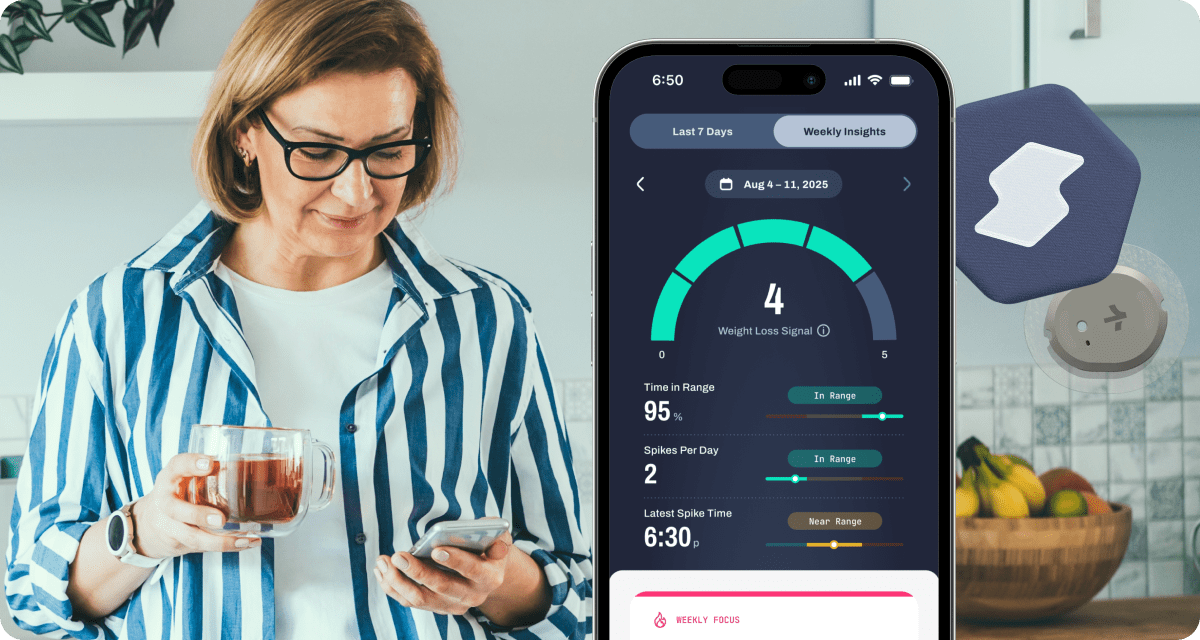
You can use Signos with a CGM as a mindfulness tool, and not a scoreboard. Your glucose levels can tell you a story that helps you better understand your body:
- Do I eat more when I’m stressed?
- Which holiday foods feel good in my body?
- How does slowing down affect my curve?
By pairing subjective emotional cues with objective data, you can identify patterns around stress and blood sugar. These cues may also help you remember to avoid skipping meals, which can lead to rebound cravings, and reinforce behaviors that support your metabolism.
The goal is curiosity, not perfection. When glucose feedback becomes a source of learning (and not judgment), it supports confidence and long-term habits.
The Bottom Line
You can enjoy the sweetness of the holidays without the chaos. When you align your mindset with your metabolism (and use data to stay aware), you build wellness habits that last far beyond the New Year.
Mindful eating during holidays isn’t about restriction; it’s about presence, satisfaction, and making compassionate choices for your body.
Learn More With Signos’ Expert Advice
Signos connects metabolic science with daily habits to support better health year-round. Signos can improve your health by helping you make supportive food choices and strengthen healthy routines during the holiday season and beyond. Learn more about glucose levels on Signos’ blog.
Topics discussed in this article:
References
- Sullivan, R. M., Wilson, D. A., Ravel, N., & Mouly, A. M. (2015). Olfactory memory networks: from emotional learning to social behaviors. Frontiers in behavioral neuroscience, 9, 36. https://doi.org/10.3389/fnbeh.2015.00036
- Volkow, N. D., Wang, G. J., & Baler, R. D. (2011). Reward, dopamine and the control of food intake: implications for obesity. Trends in cognitive sciences, 15(1), 37–46. https://doi.org/10.1016/j.tics.2010.11.00
- Stevenson R. J. (2024). The psychological basis of hunger and its dysfunctions. Nutrition reviews, 82(10), 1444–1454. https://doi.org/10.1093/nutrit/nuad092
- Fuente González, C. E., Chávez-Servín, J. L., de la Torre-Carbot, K., Ronquillo González, D., Aguilera Barreiro, M. L. Á., & Ojeda Navarro, L. R. (2022). Relationship between Emotional Eating, Consumption of Hyperpalatable Energy-Dense Foods, and Indicators of Nutritional Status: A Systematic Review. Journal of obesity, 2022, 4243868. https://doi.org/10.1155/2022/4243868
- Shukla, A. P., Karan, A., Hootman, K. C., Graves, M., Steller, I., Abel, B., Giannita, A., Tils, J., Hayashi, L., O'Connor, M., Casper, A. J., D'Angelo, D., & Aronne, L. J. (2023). A Randomized Controlled Pilot Study of the Food Order Behavioral Intervention in Prediabetes. Nutrients, 15(20), 4452. https://doi.org/10.3390/nu15204452

.svg)






.svg)
.svg)
.svg)
.svg)
.svg)
.svg)
.svg)
