


Key Takeaways
- Hungryroot and Factor are two of the best meal delivery services, with each offering unique products and meals.
- Hungryroot offers grocery items and quick meal kits with greater customization, while Factor provides single-serving, ready-to-eat meals with predictable portions and macronutrients for maximum convenience.
- Hungryroot suits those who want simple home-prepared meals with variety, while Factor works well for individuals seeking premade, portion-controlled options.
that {{mid-cta}}
Meal delivery services promise convenience, but not all are created equal for metabolism and glucose stability. While many meal delivery services provide healthy meal kits, each person’s dietary needs are unique. Let’s compare two of the best meal delivery services (Hungryroot and Factor) to see which better supports your health goals and glucose stability.
Overview of Hungryroot

Hungryroot provides flexibility and convenience for healthy eating.
Hungryroot was established as a grocery delivery service, meaning they provide you with groceries and easy recipes, but has since evolved into a one-stop shop for groceries, recipes, fresh ingredients, ready-to-eat meals, and supplements.
A personalized quiz at sign-up collects information on dietary preferences, eating habits, lifestyle, and goals. Quiz results are then translated into a grocery shopping list and meal plan.
A food profile lets you customize your cuisine and flavor preferences, food dislikes, cook time, meal prep time, and access to kitchen appliances. Hungryroot focuses on more plant-based meal options and offers preservative-free foods for a variety of dietary needs, including gluten-free and low-calorie options.
Overview of Factor
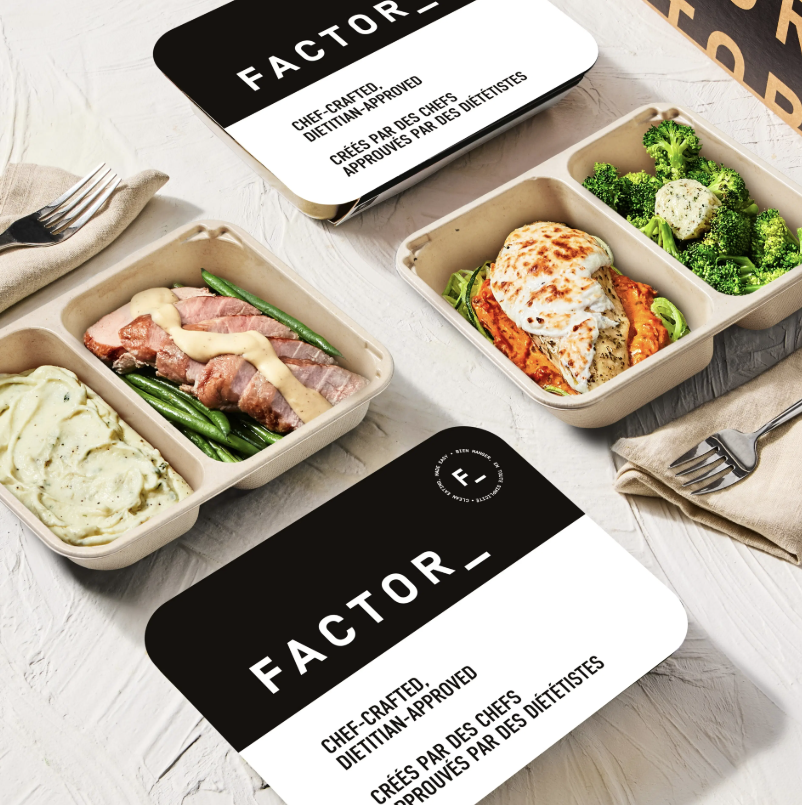
Don’t want to deal with the hassle of cooking? Factor may be the better option. Factor provides single-serving, ready-to-eat, fresh, never-frozen, chef-prepared meals. All you have to do is heat and eat your meal.
Factor offers chef-crafted, registered dietitian-approved meals to help you stay on target with your nutrition goals. Factor offers eight diet-specific weekly menus to choose from, including high-protein, keto, carb-conscious, calorie-smart, and high-protein.
Each meal provides the nutrition you need to support your health goals and preferences. Factor meals include a mix of carbohydrates, protein, and fats for well-rounded nutrition, simplified.
With Factor, you get convenient dishes that require minimal meal prep and are always macronutrient-balanced. Factor offers other add-ons, such as smoothies, breakfast, and snacks.
Nutrition and Metabolic Perspective

Controlled calories to remove the guesswork from your plate.
Portion control made easy with single-serving, ready-to-eat meals. Factor further simplifies calorie counting with nutrition information on the packaging. Hungryroot lists all nutrition information for grocery items, meal kits, and premade meals on its website.
Hungryroot provides more fiber.
Hungryroot’s ready-to-eat meals tend to be higher in carbohydrates and fiber than Factor’s meals. Even Factor’s fiber-filled, premade meals do not match Hungryroot’s fiber content. Dietary fiber slows the digestion and absorption of carbohydrates, leading to steadier glucose levels. High-fiber diets improve glycemic control and support weight management, ideal for metabolic health.1
Factor meals are higher in saturated fat.
Many Factor meals are high in saturated fats because they rely on animal meats to meet higher protein needs. Research shows that replacing carbohydrates with saturated fats has little effect on glucose and insulin levels. However, replacing carbohydrates or saturated fats with unsaturated fats, specifically polyunsaturated fats, reduces hemoglobin A1c and insulin levels, as well as markers of insulin resistance.2
Some Factor meals have upwards of 20 grams of saturated fat, far above the American Heart Association’s recommendation to keep saturated fat below 6% of total calories or less than 13 grams per day on a 2,000-calorie diet.3
Hungryroot offers a few ready-to-eat meals with red meat and allows greater customization with groceries and recipes, so you can keep saturated fat intake low for metabolic health.
Protein remains similar across Hungryroot and Factor.
Protein portions in Hungryroot meals and Factor are relatively similar, with most prepared meals containing 20 to 30 grams per serving. Factor’s high-protein or low-carb entrees often contain more. Protein-rich diets support weight loss and influence body composition, decreasing fat mass while preserving fat-free mass.4 Eating more protein influences appetite-related hormones, increasing satiety and positively affecting eating habits.5
Convenience and Lifestyle Fit

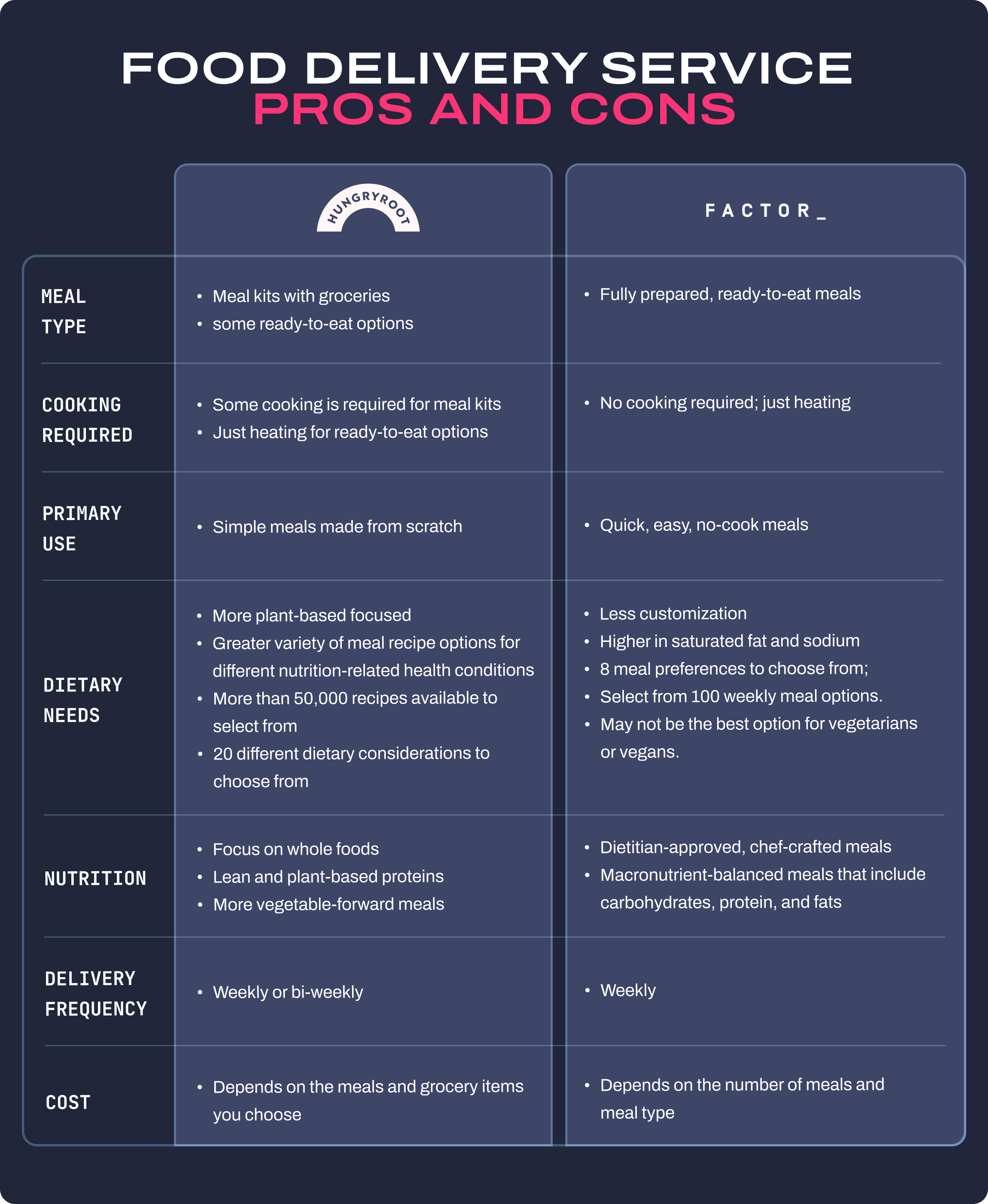
If you regularly eat meals out of the house, a meal delivery service may be a great option, as it can be more affordable and healthier than takeout. But deciding between Factor and Hungryroot depends on your health goals, dietary needs, and individual preferences.
- Replace grocery shopping with Hungryroot. Hungryroot cuts the time you spend at the grocery store by providing you with the grocery items and recipes that match your lifestyle and needs. In addition to meal-specific ingredients, Hungryroot lets you buy general groceries, including snacks and supplements.
- Hungryroot may be more of a traditional meal kit delivery service, providing high-quality ingredients for home-cooked meals. Most Hungryroot recipes take less than 15 minutes to prepare. Conversely, Factor acts as a takeout replacement, delivering single-serving, premade meals ready to heat and eat.
- Hungryroot is the better option for families, with highly customizable grocery items and recipes, rather than Factor's ready-to-eat, single-serving options. If you have specific dietary needs, such as requiring vegan meals, opt for Hungryroot, which caters to more plant-based eaters.
- Individuals with few dietary restrictions looking for highly convenient, quick meals with minimal preparation should opt for Factor.
Signos Integration: Personalizing Meal Choices
.png)
Signos turns every meal into a real-world experiment. By pairing a CGM with in-app logging, you can see (meal by meal) how Factor or Hungryroot dishes impact your glucose, energy, and cravings.
See How Each Meal Affects You
Log each meal in the Signos app and watch your glucose response over the next 2–3 hours. Instead of guessing, you get immediate feedback on what helps you stay steady versus what sends your glucose climbing.
Signos features at work
- Continuous glucose monitoring for real-time feedback
- Meal logging to connect food choices to glucose curves
- Clear visual trends that highlight smoother vs. spikier responses
Build a Better Weekly Menu
Over time, patterns emerge. You’ll start to see which meals keep your glucose in a smoother range and which ones lead to sharper rises and drops. Use those insights to guide your weekly selections.
What to look for:
- Meals that create a flatter, more stable curve
- Protein- and fiber-forward dishes that sustain energy
- Higher-carb meals that may need small tweaks
Run Simple, High-Impact Meal Experiments
Use Signos to test small changes and see the difference in real time.
Try these experiments:
- Compare two similar meals with different protein amounts
- Swap a sugary or creamy sauce for a lighter option
- Choose a veggie-forward dish vs. a higher-carb alternative
- Add extra fiber (vegetables, legumes) to the same base meal
Layer in Proven Glucose-Stabilizing Strategies
Signos helps you see how behaviors beyond food shape your response.
Behavior experiments to test:
- Meal sequencing: Eat protein and veggies first, carbs last
- Post-meal movement: Take a 5–10 minute walk after eating
- Timing awareness: Compare earlier vs. later meals
Watch how these habits change your glucose curve, and keep the ones that work.
The Bottom Line
Regardless of which option you choose, you’re bound to get delicious meals. Both Hungryroot and Factor have unique strengths. Which meal subscription service is better for you depends on your lifestyle, preferences, diet, and metabolic goals. With Signos, you can see precisely how each meal affects your glucose and make data-driven choices to stay on track.
Learn More With Signos’ Expert Advice
Signos allow you to see how your glucose responds to different macronutrient combinations. Experiment with the various meal options and see how each affects your glucose levels. Then choose the meal delivery service that best suits your needs to improve your overall health.
Learn more about glucose levels and tracking on Signos’ expert-written, evidence-based blog.
Topics discussed in this article:
References
1. Nitzke, D., Czermainski, J., Rosa, C., Coghetto, C., Fernandes, S. A., & Carteri, R. B. (2024). Increasing dietary fiber intake for type 2 diabetes mellitus management: A systematic review. World journal of diabetes, 15(5), 1001–1010. https://doi.org/10.4239/wjd.v15.i5.1001
2. Imamura, F., Micha, R., Wu, J. H. Y., De Oliveira Otto, M. C., Otite, F. O., Abioye, A. I., & Mozaffarian, D. (2016). Effects of saturated fat, polyunsaturated fat, monounsaturated fat, and carbohydrate on glucose-insulin homeostasis: A systematic review and meta-analysis of randomised controlled feeding trials. PLOS Medicine, 13(7), e1002087. https://doi.org/10.1371/journal.pmed.1002087
3. Saturated fat. (n.d.). Www.Heart.Org. Retrieved November 19, 2025, from https://www.heart.org/en/healthy-living/healthy-eating/eat-smart/fats/saturated-fats
4. Moon, J., & Koh, G. (2020). Clinical Evidence and Mechanisms of High-Protein Diet-Induced Weight Loss. Journal of obesity & metabolic syndrome, 29(3), 166–173. https://doi.org/10.7570/jomes20028
5. Guarneiri, L. L., Kirkpatrick, C. F., & Maki, K. C. (2025). Protein, fiber, and exercise: a narrative review of their roles in weight management and cardiometabolic health. Lipids in health and disease, 24(1), 237. https://doi.org/10.1186/s12944-025-02659-7

.svg)


.jpg)







.svg)
.svg)
.svg)
.svg)
.svg)
.svg)
.svg)
