

.jpg)
If you’ve spent any time on health and fitness social media accounts lately, or your algorithm is highly tuned into this content at the start of the new year, then you’ve likely seen the “12-3-30” workout promised as a simple, highly effective secret to burning fat and achieving weight loss. The routine sounds deceptively easy: set a treadmill to a 12% incline, walk at 3.0 mph, and sustain this effort for 30 minutes straight.
Yet, for those just starting their health and fitness journey, the leap from a casual stroll to a steep, heart-pumping climb can be daunting and potentially risky from an injury perspective. Is this viral trend a legitimate tool for shedding pounds, or is it just another fitness fad that leaves you feeling exhausted, frustrated, and discouraged?
In this guide, we’ll help you understand the structure of the 12-3-30 workout, break down the science behind the boasted effects, and ultimately provide an evidence-based overview of how this workout may affect your body with safe modifications to see real, sustainable weight loss results. So 3, 2, 1, let’s 12-3-30.
What Is the 12-3-30 Workout?
.jpg)
Many beginners see an influencer gain a sculpted physique after trying the "12-3-30" workout and immediately jump onto a treadmill without understanding the true mechanics and definition. However, this can create confusion about what the numbers mean, how often it should be done, or whether holding onto the handrails for support is necessary.
Spoiler: A 2000 study in Research in Nursing and Health found that using a handrail while exercising on a treadmill, even lightly, reduced intensity and yielded suboptimal benefits for overall health.1
Doing this reduces the workout's effectiveness, burns fewer calories, and may strain the wrists and shoulders rather than engaging the core and leg muscles sufficiently. As you can see, understanding the parameters of the 12-3-30 workout is crucial to achieving optimal results.
The 12-3-30 workout is a steady-state walking routine performed on a treadmill. It was pioneered by social media influencer Lauren Giraldo, who first shared the routine on YouTube in 2019, which then led to a classic viral explosion on TikTok soon after.2 By focusing on a steep incline rather than high speed, she created a low-impact way to significantly elevate the heart rate and build lower-body strength in a single workout.
What started as one person’s solution for fitness has since become a globally recognized routine, praised by fitness experts and supported in scientific literature as a more advantageous alternative to self-paced running.3
How to Do the 12-3-30 Treadmill Workout
.jpg)
To begin, it’s important to understand exactly what the numbers mean in relation to the workout parameters. The exact setup includes:
- 12: Set the treadmill incline to 12%.
- 3: Set the speed to 3.0 mph.
- 30: Walk for a total of 30 minutes.
The biggest hurdle isn't the 30-minute duration, but the steep 12% incline, which can feel like climbing a never-ending mountain. Many new exercisers jump straight into the full settings and quickly find themselves gripping the treadmill handrails as hard as they can just to stay upright. To perform the 12-3-30 workout safely and effectively, start with a 5-minute warm-up at 0% incline and 2.5 mph to increase blood flow, lubricate your joints, and activate the right muscles.
Once you begin the workout, maintain an upright posture with a neutral spine and a core engaged, allowing your arms to swing naturally. If you cannot perform the workout without holding onto the handrails, the best solution is to start at a 5% incline (or at an incline that feels doable without hand support) and gradually work your way up over several weeks to 12%, where the real strengthening and metabolic magic happens.4
This gradual progression ensures your cardiovascular system and "posterior chain" muscles (calves, hamstrings, and glutes) strengthen appropriately and safely, leading to better long-term results and consistent weight loss progress without injury or frustration.
Does the 12-3-30 Workout Work for Weight Loss?
.jpg)
There is a common misconception that 12-3-30 is a "miracle" fat-burner that works faster than running or other high-intensity interval training options. If you discovered 12-3-30 on social media, you may have found yourself searching for "before and after" photos and noticing insane transformations, such as losing 30 pounds in a month or gaining noticeable muscle tone in just 4 weeks.
Unfortunately, this creates unrealistic expectations, especially when the scale doesn’t budge immediately. Remember that without a caloric deficit in our diet, even the most intense treadmill session won't result in weight loss.
Recent research suggests the 12-3-30 workout is a highly effective moderate-intensity exercise for weight loss, specifically because it burns a high number of calories in 30 minutes and increases the utilization of fat as an energy source.3
Additionally, a study in the International Journal of Research in Exercise Physiology found the 12-3-30 created high levels of participant satisfaction in exercise, with most saying the 12-3-30 workout made them feel “very good” afterwards and increased their likelihood of remaining consistent.5
12-3-30 Workout Calories Burned
The study by Wong et al. in The International Journal of Exercise Science found that participants who performed the 12-3-30 workout burned approximately 300 calories, comparable to the calories burned by the same individuals running at a steady state on a treadmill.3 Another study in 2011 in Medicine and Science in Sports and Exercise found inclined treadmill walking led to obese individuals burning around 220 calories in 30 minutes at only a 6% incline, likely meaning more calories would be burned if the incline were higher.6
So, does the 12-3-30 workout actually work for weight loss? According to the scientific literature, the answer is yes. The research cited above confirms that walking on a 12% incline significantly elevates heart rate and oxygen consumption, thereby increasing caloric burn compared with walking on flat ground. If you are looking for a low-impact, short-duration exercise that targets cardiovascular health, muscle strength, and weight loss in one, the 12-3-20 workout may be the evidence-informed pathway to fat loss you enjoy at the gym.
How Often Should You Do the 12-3-30 Workout?
The biggest risk for a beginner is going from the couch to 12-3-30 too quickly. Starting this method with minimal activity and progressing to a 12% incline can lead to injuries such as calf strains, hip pain, Achilles tendonitis, or lower back pain due toincreased strength demands on your core and legs during incline walking. Despite most of the benefits of this method occurring at higher inclines, keep in mind you do not have to start there. Consistency in a new habit is a great win to celebrate. If you are new to exercise or new to incline walking, use the following intro plan to help build your strength and stamina over four weeks:
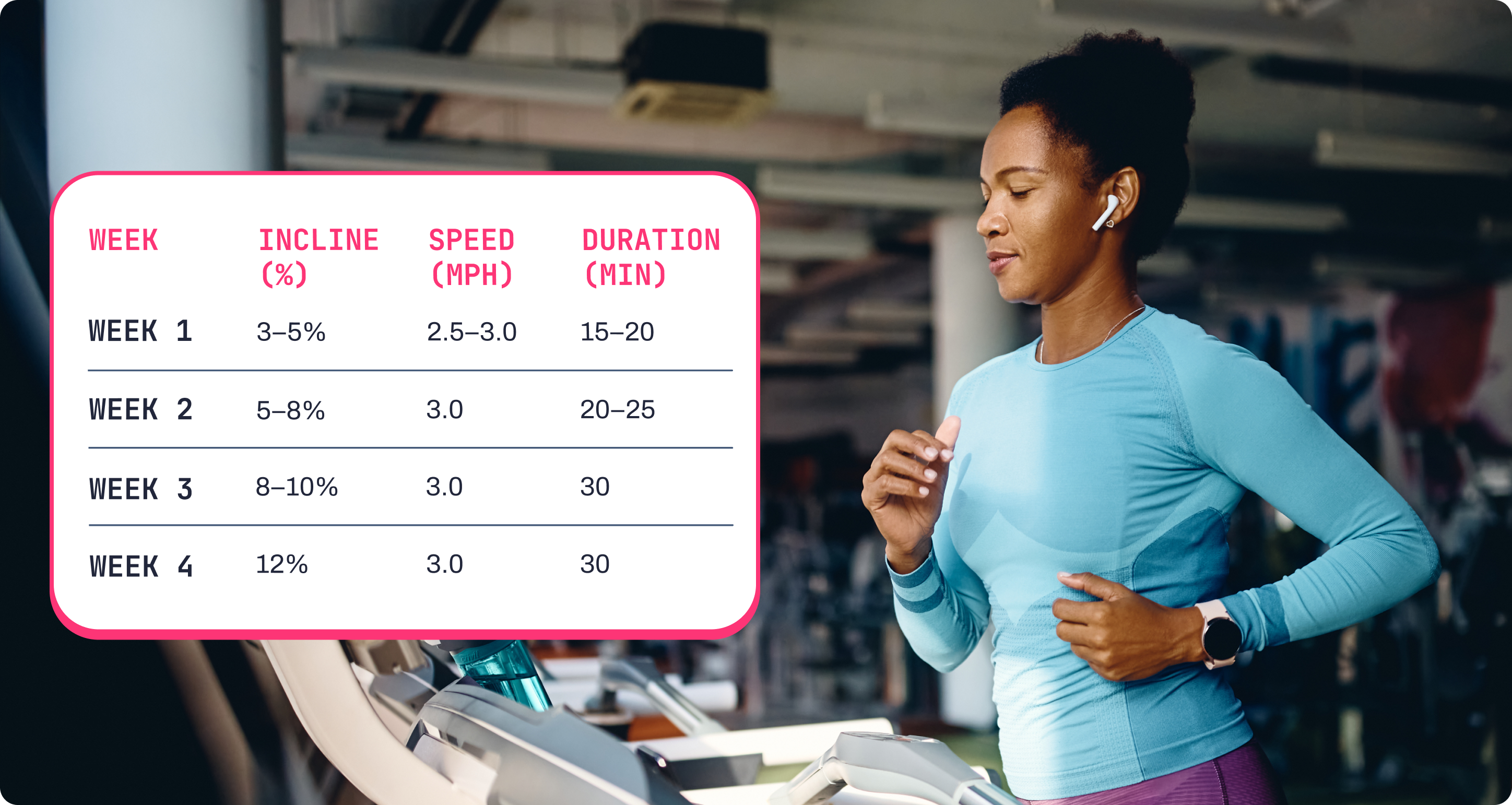
For sustainable weight loss results, it is recommended to perform the 12-3-30 workout 3 to 5 times per week. This frequency allows for the 150 minutes of moderate-to-vigorous activity recommended by health organizations while leaving sufficient days for muscle recovery and opportunities for additional physical activity, such as strength training, yoga, or tai chi.
It is important to realize that recent scientific literature is recognizing the need for more physical activity each week to achieve weight loss and body composition changes, especially for those who are overweight or obese, upwards of 300 minutes to be exact.7 Thus, the 12-3-30 workout helps you obtain close to 150 minutes while allowing time for additional movement to keep you well-rounded, strong, and healthy.
When should you expect to see results? While you may notice increased energy and stamina within the first 2 weeks, visible weight loss and changes in body composition typically require 4 to 12 weeks of consistent effort paired with a balanced diet. Consider incorporating a continuous glucose monitor, such as Signos, which monitors your blood sugar in real time and provides insights on when to exercise and when not to.
For example, if your Signos data shows that your glucose levels remain elevated or "spikey" the day after a 12-3-30 workout session, it may indicate that your body needs an extra rest day. You can also use the app to see how a 12-3-30 session effectively blunts post-meal glucose spikes, helping you strategically time your workouts to maximize fat burning and metabolic stability.
Common Mistakes With the 12-3-30 Workout
.jpg)
To help you navigate your first few weeks successfully, recognize that while the 12-3-30 setup is simple, execution is where most people struggle. Avoiding these common mistakes will ensure you stay injury-free and maximize your caloric expenditure while remaining consistent in your weight-loss journey.
1. Holding Onto the Handrails: When you grip the rails and lean back, you effectively neutralize the incline and reduce the work your body has to do. If you feel like you're going to fall, lower the incline to 5-6% until you can walk with a natural arm swing. This engages your core and posterior chain correctly and increases caloric burn.
2. Neglecting a Warm-Up: Jumping straight to a 12% grade puts immediate, intense stress on your tendons and ligaments. Dedicate at least 5 minutes to walking at 2.5–3.0 mph at 0% incline to help increase blood flow and prepare your body for the work ahead. You can also incorporate a few dynamic calf, quad, and hamstring stretches while standing next to the treadmill before stepping onto the belt.
3. Prioritizing the Numbers Over Form: Many individuals force maintaining the "12" incline even if their form breaks down, leading to excessive rounding of the lower back or "heavy" stepping. Focus on a "mid-foot" landing rather than heavily on your heels. If you find your lower back begins to ache, it’s a sign that your core is fatigued or your posture is failing. Lower the incline immediately to maintain a safe, upright position while continuing to walk for 30 minutes.
4. Wearing Unsupportive Shoes: The mechanics of incline walking place unique pressure on your foot arch and ankles. Using worn-out sneakers or shoes designed for flat-surface walking can lead to injuries like plantar fasciitis. Use a high-quality running or walking shoe with ample arch support and heel height (versus flat shoes). This helps absorb the increased force from the incline and protects your joints over the 30-minute period.
5. Overdoing it: Because it's "just walking," many try to do 12-3-30 every single day without rest. This often leads to cumulative fatigue, elevated inflammation, and a plateau in weight loss. Treat this like a high-intensity workout. Schedule at least one to two days of active or full recovery per week to allow your muscle fibers to repair and your metabolism to stabilize.
Bottom Line
The 12-3-30 workout is a proven, evidence-supported strategy that bridges the gap between a casual stroll and a high-intensity run. By committing to this routine 3 to 5 times per week, focusing on proper form without using the handrails, and using tools like a CGM to monitor your metabolic recovery, you can turn a social media trend into a lifelong health habit that actually works for you. By viewing this as a long, steady journey rather than a 30-day sprint, you allow your metabolism to adjust and your muscles to tone, leading to true, lasting "before and after" results seen in viral success stories. Except now the success story is your own.
Learn More About Signos’ Expert Advice
If you have more questions on improving your health, fitness, and nutrition, seek the expert advice of the Signos continuous glucose monitor and the Signos team. A continuous glucose monitor (CGM) can provide insights to support smarter nutrition and exercise choices. The Signos app provides a unique, personalized program to help you reach your health goals.
FAQ
1. What is the 12-3-30 workout?
The 12-3-30 is a treadmill routine where you set the incline to 12% and the speed to 3.0 mph, then walk for a continuous 30 minutes. It is a low-impact steady-state cardio workout designed to build endurance and burn fat.
2. Is the 12-3-30 workout effective?
Yes, it is an effective way to elevate your heart rate and improve cardiovascular health without excessive joint stress. Scientific evidence shows that walking on a steep incline significantly increases calorie burn and lower-leg muscle strength.
3. How many calories does the 12-3-30 workout burn?
An average individual can expect to burn 250-300 calories per session, depending on their weight, fitness level, and effort.
4. Does the 12-3-30 workout help you lose weight?
It is an excellent tool for weight loss because it can contribute to a consistent caloric deficit when performed 3–5 times per week. For best results, it should be paired with a balanced diet and strength training focused on long-term consistency.
5. How to start the 12-3-30 workout as a beginner?
Beginners should start with a 5-minute warm-up at a lower incline, such as 3% or 5%, and gradually increase the grade over several weeks as their stamina improves. Try to avoid holding the handrails so that your body carries its own weight, maximizing the effectiveness of the exercise.
Topics discussed in this article:
References
- Christman, S. K., Fish, A. F., Bernhard, L., Frid, D. J., Smith, B. A., & Mitchell, L. (2000). Continuous handrail support, oxygen uptake, and heart rate in women during submaximal step treadmill exercise. Research in nursing & health, 23(1), 35–42. https://doi.org/10.1002/(sici)1098-240x(200002)23:1<35::aid-nur5>3.0.co;2-i
- Lawton, K. (2021, December 30). What is the 12-3-30 workout? And does it work? Cleveland Clinic. https://health.clevelandclinic.org/12-3-30-workout
- Wong, M. W. H., Davis, D. W., Perez, O. R., Weyers, B., Green, D. M., Garcia, A. V., & Navalta, J. W. (2025). An Exploratory Study Comparing the Metabolic Responses between the 12-3-30 Treadmill Workout and Self-Paced Treadmill Running. International journal of exercise science, 18(6), 56–64. https://doi.org/10.70252/UBIX5911
- Silder, A., Besier, T., & Delp, S. L. (2012). Predicting the metabolic cost of incline walking from muscle activity and walking mechanics. Journal of biomechanics, 45(10), 1842–1849. https://doi.org/10.1016/j.jbiomech.2012.03.032
- Pelino, L. M., Diaz, J., & Dalleck, L. C. (2024). Physiological responses of the 12-3-30 workout: Exercise myth or reality. International Journal of Research in Exercise Physiology, 20(1). https://ijrep.org/physiological-responses-of-the-12-3-30-workout-exercise-myth-or-reality/
- Ehlen, K. A., RAOUL F REISER, I. I., & Browning, R. C. (2011). Energetics and biomechanics of inclined treadmill walking in obese adults. Medicine & Science in Sports & Exercise, 43(7), 1251-1259.
- Jayedi, A., Soltani, S., Emadi, A., Zargar, M. S., & Najafi, A. (2024). Aerobic Exercise and Weight Loss in Adults: A Systematic Review and Dose-Response Meta-Analysis. JAMA network open, 7(12), e2452185. https://doi.org/10.1001/jamanetworkopen.2024.52185

.svg)







.svg)
.svg)
.svg)
.svg)
.svg)
.svg)
.svg)
